
How to Search San Bernardino County Probate Records
Start at the Court Access Portal at cap.sb-court.org. The portal covers civil, family, probate and mental health filings across all 13 court facilities. Use Case Search for a quick lookup by name or case number. Use Advanced Search to filter by date or by the Probate / Mental Health case category.
The Case Category drop-down on Advanced Search lists Probate / Mental Health. Pick that to limit results to estates, guardianships, conservatorships and LPS matters. The case-number jurisdiction code for probate is PS. A docket with PS in the case number is a Probate Division file, not a civil or family case.
- Open the Court Access Portal at cap.sb-court.org and click Case Search.
- Type the last name first, then the first name. Or paste the full case number.
- Switch to Advanced Search and pick Case Category Probate / Mental Health to narrow the list.
- Click a result to see the docket, hearing list, and party data.
- For paper exhibits, lodged wills or sealed minor files, go to the Probate counter at the Justice Center.
The will custodian is named on the leginfo.legislature.ca.gov Probate Code section that controls will deposit duties.
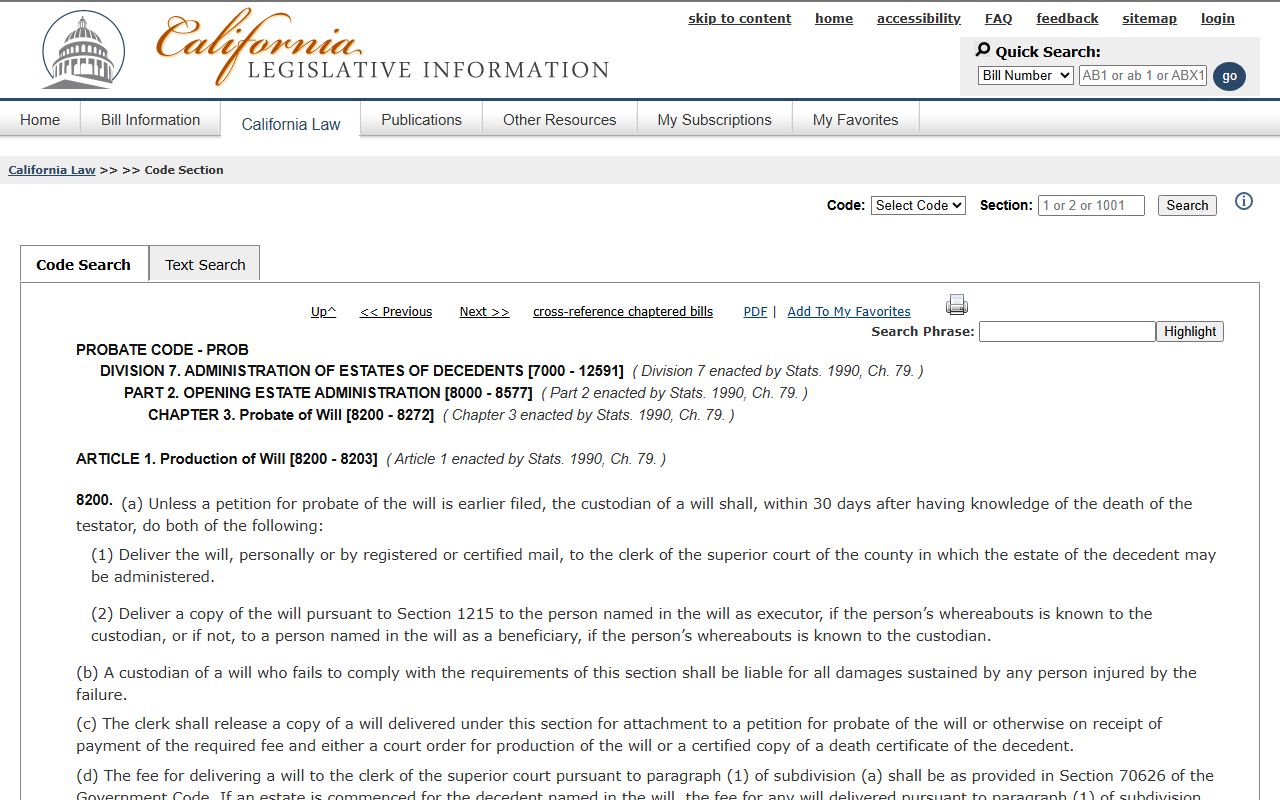
Whoever holds an original will is the custodian for that document. The duty to file is set by statute and runs from the date of death.
The San Bernardino County Probate Division
The Probate Division sits inside the San Bernardino Justice Center in downtown San Bernardino. The Justice Center handles the bulk of estate, guardianship and conservatorship work for the county. Counter hours are Monday to Friday, 8:00 a.m. to 4:00 p.m. The lobby opens at 7:30 a.m. A drop box sits on the south side of the building at the bottom of the stairs. Documents dropped before 4:00 p.m. are filed the same date and processed the next business day.
San Bernardino Justice Center, Probate Division
247 West Third Street
San Bernardino, CA 92415-0212
909-521-3388
Fax: 909-521-3387
Mon-Fri 8:00 a.m. to 4:00 p.m. (lobby 7:30 a.m.)
The Probate page on the court site lists parking, directions and the drop-box rules. Court-side parking is tight, so confirm the lot before you go.
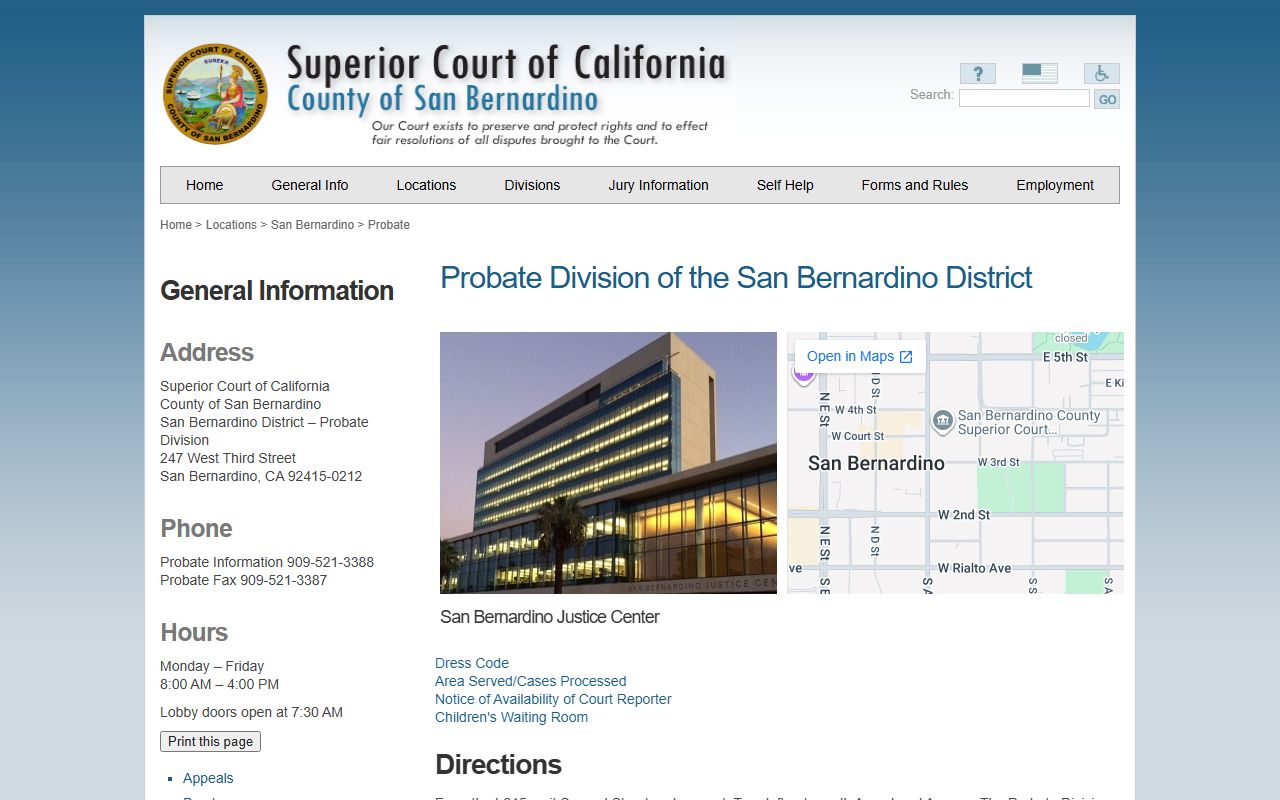
The same page sets out dress code, area served, and notice-of-court-reporter rules.
What San Bernardino County Probate Records Cover
Probate is a broad case type, not just wills. A San Bernardino County probate file can be any of these matters.
Decedent estates make up most of the docket. The file holds the petition, the will if one was lodged, the order for probate, letters testamentary or letters of administration, the inventory and appraisal, creditor notices, the final account, and the order for distribution. Title companies pull these files to confirm a real-estate chain of title.
Guardianship cases cover children whose parents are gone, missing or unfit. The court appoints a guardian of the person, a guardian of the estate, or both. Some minor guardianship records are restricted. Conservatorship cases cover adults who can no longer manage themselves or their money. Mental health filings under the LPS Act sit on a separate calendar with tighter access rules.
How Probate Works in San Bernardino County
The California probate process moves in a set order. Each step adds new documents to the case file, so the docket grows from the first petition to the final distribution.
- Petition. An interested party files a petition for probate, the lodged will and the death record. The clerk opens a case number with the PS code.
- Notice. Notice goes to heirs, beneficiaries and named creditors. Publication runs in a local paper of general circulation.
- Hearing and order. The court hears the petition, admits the will and signs the order for probate. Letters issue to the personal representative.
- Inventory and appraisal. The representative lists every asset. A probate referee values non-cash items and the inventory gets filed.
- Creditor notice. Known creditors get direct notice. The four-month window runs from the date letters issued.
- Accounting. The representative files an account that shows receipts, gains, losses, distributions and any fees.
- Distribution. The court signs the order for final distribution. Assets pass to heirs and the case closes.
Contested estates, real property sales, missing heirs and conservatorship disputes can stretch this timeline. A simple estate may close in nine to twelve months. A fight over a will or a sale of a house can push it past two years.
San Bernardino County Probate Code Highlights
Two statutes carry most of the weight for people who walk into a Probate counter for the first time. Both are on the official California legislative info site.
Probate Code § 8200 sets the duty of the will custodian. Whoever holds the original will must deliver it to the clerk of the superior court of the county where the estate is to be probated, and must send a copy to the named executor. The deadline runs from the date the custodian learns of the death. The full text is on leginfo.legislature.ca.gov.
Probate Code § 13100 sets the small estate affidavit procedure. When the gross value of the decedent's personal property in California is at or below the statutory threshold, an heir can collect that property by a signed affidavit, with no full probate case. The affidavit cannot be used for real property and cannot be used before the 40-day waiting period runs.
The small estate procedure is a real shortcut for modest estates. The text and the threshold sit on leginfo.legislature.ca.gov.
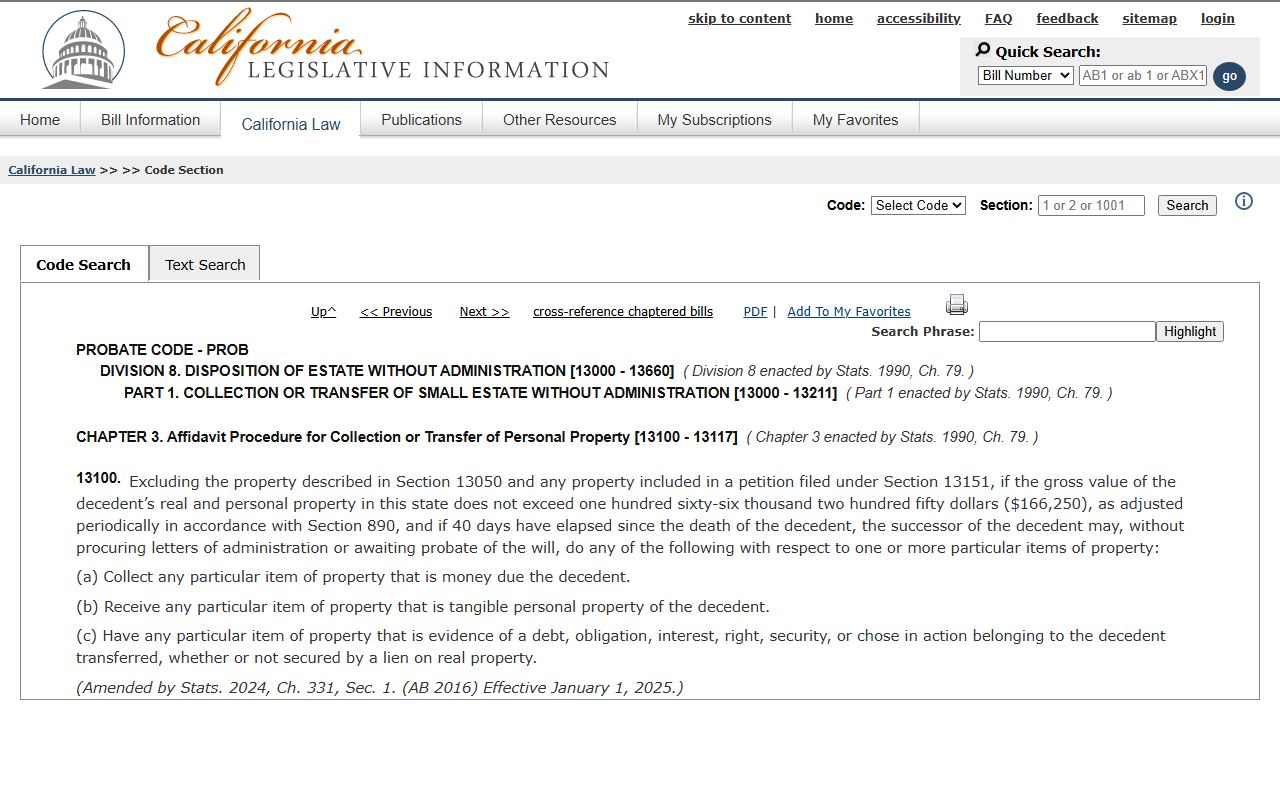
Banks and credit unions in the county will accept a § 13100 affidavit when the statutory checklist is met.
Court Record Retention Under Gov. Code § 68152
California trial courts follow a retention schedule set by state law. Government Code § 68152 holds the master schedule for trial court records, and probate sits in the long-retention tier. The full text is at leginfo.legislature.ca.gov.
Many probate orders, judgments, decrees, wills, inventories and the related indexes carry permanent or long-term retention. Old files from the 1970s, 1980s and 1990s often still exist in the court warehouse or on microfilm. They may not be online. They may take a written request, a fee and some wait time to pull, but they are usually still findable. Mental health and certain guardianship files have shorter or restricted retention. Confirm with the Probate counter before you assume an old file is gone.
San Bernardino County Probate Terms Defined
Probate has its own vocabulary. The terms in a case docket can throw off a first-time reader. Here is a short glossary that tracks the words used in San Bernardino County probate filings.
- Testator
- The person who made the will.
- Executor
- The person named in the will to carry out its terms. Once the court signs the order, the executor receives letters testamentary.
- Intestate
- Dying without a valid will. The estate passes under California's intestate succession rules to the surviving spouse, children and other heirs.
- Administrator
- The personal representative the court appoints when there is no will or when the named executor cannot serve.
- Conservator
- An adult appointed to manage the person, the estate, or both for another adult who cannot do so.
- Conservatorship
- The case and the order that names a conservator. A probate conservatorship differs from an LPS conservatorship.
- Guardian
- An adult appointed to manage a minor child's person or estate.
- Guardianship
- The case that sets the guardian's role and powers. Some minor files have access limits.
- Beneficiary
- A person or entity named in a will or trust to receive a share of the estate.
- Heir
- A person who takes under intestate succession when there is no will.
- Decedent
- The person who died.
San Bernardino County Probate Filing Fees
The court charges a filing fee for the original probate petition and for many later filings. State law sets most of the base fees, with local add-ons on top. The current fee schedule PDF was not captured during research. Verify the live amounts at the Probate counter or on the court's fee schedule before filing.
| Item | Amount |
|---|---|
| Original petition for probate (statewide base) | Verify with court counter |
| Petition to administer estate | Verify with court counter |
| Letters testamentary or letters of administration | Verify with court counter |
| Guardianship petition | Verify with court counter |
| Conservatorship petition | Verify with court counter |
| Certified copy fees (Recorder/County Clerk side) | See the Assessor-Recorder-County Clerk schedule |
The Assessor-Recorder-County Clerk handles death record copies, which often pair with a probate filing. Their fee list is on the ARC site. The court counter charges its own per-page certified copy fee for letters, orders and decrees from the probate file.
Contested San Bernardino County Estates and Probate Litigation
Not every estate moves in a straight line. A will contest, a trust fight, or a battle over who serves as conservator can turn a probate case into a full lawsuit. Will contests challenge the document on grounds of capacity, undue influence, fraud, or improper execution. The contest is filed in the same probate case but uses civil-style pleadings and discovery.
Trust disputes often start in probate too. A petition under Probate Code § 17200 lets a trustee or a beneficiary ask the court for instructions, to remove a trustee, or to compel an accounting. These § 17200 petitions show up in the same Probate / Mental Health case category on the Court Access Portal.
San Bernardino County Mental Health Proceedings
Mental health matters sit inside the Probate / Mental Health case category but are not open the same way an estate file is. Access is restricted by state law. The public docket may show the case number and the hearing date, but the underlying records are sealed to non-parties.
LPS conservatorships under the Lanterman-Petris-Short Act are the most common filing on this calendar. The case looks at grave disability from a mental disorder, a chronic alcohol or drug condition, or both. Holdings are short, often one year, and must be renewed by a new petition. Counsel is appointed for the proposed conservatee at no cost.
Related San Bernardino County Records
Probate sits next to several other record sets at the same court. The Family Law Division handles dissolution, support and parentage cases. The location page for Family Law is on the legacy court site.
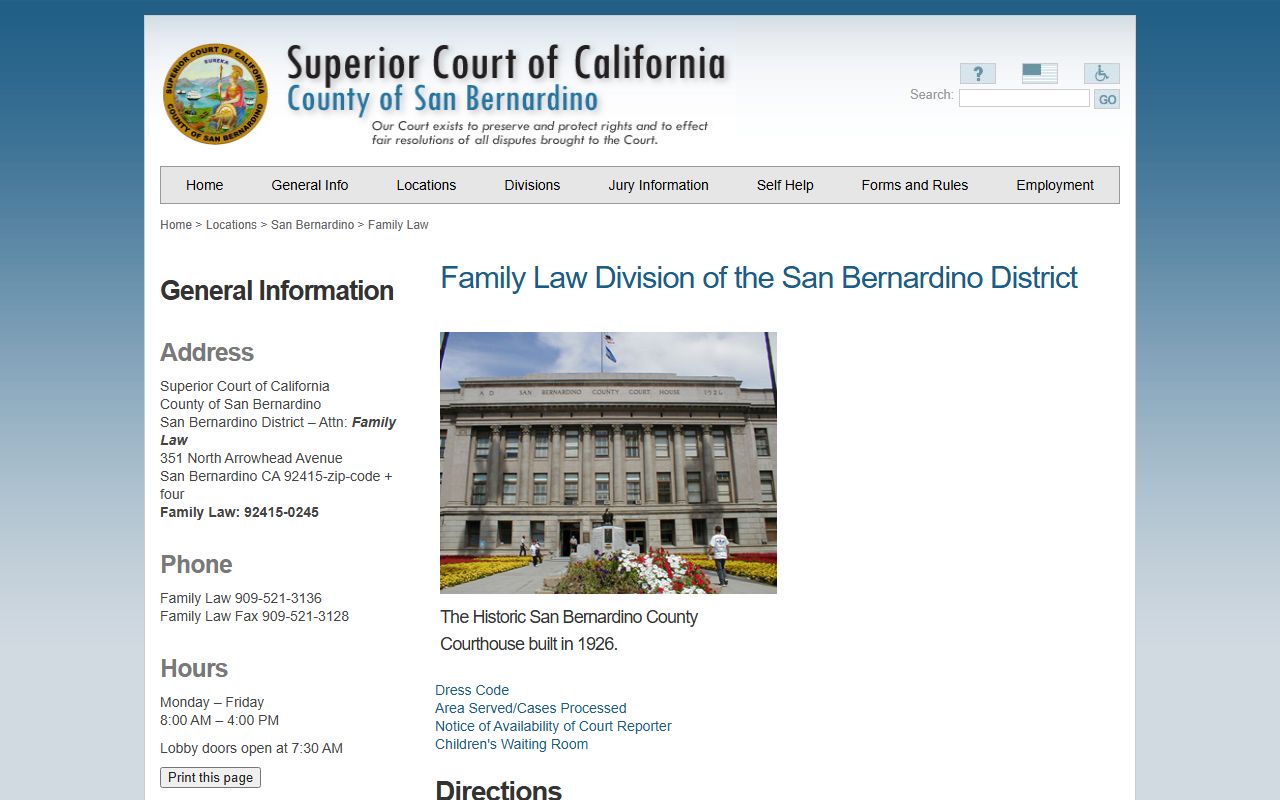
An estate sometimes runs in parallel with a family law case, since a pending divorce can change who inherits. For marriage license and divorce filings see marriage and divorce records.
Probate appeals go to the Fourth Appellate District, Division Two. The court's Appeals location page sets out the appellate routes that apply to probate orders.
Orders for distribution, orders admitting a will, and § 17200 trust petition orders are all appealable within the time limits in the California Rules of Court. For non-case court records see public records. For counter filing rules see Clerk of Superior Court. For broader case-search help see court records.